Marginalization of Marginalia
Two recent pieces have emphasized the marginalization of marginalia in our increasingly digital world.
Mark Sample at the Profhacker blog has an interesting post on Going Paperless at Conferences. In Mark’s case, the conference in question was the recent MLA and the paperless alternative was an iPad. His post has a technological rundown of apps used as well as a list of pros and cons for going paperless. The latter category was dominated by a lament of lost marginalia:
The chief disadvantage of presenting paperlessly isn’t the actual presentation. It’s what happens afterward, in the discussion period of the panel. I missed not being able to quickly jot down ideas and questions from the audience directly onto my paper. I can type fairly quickly on the iPad, but there’s nothing like leaving actual marginalia.
This gripe was especially poignant in light of a recent New York Times piece entitled “Book Lovers Fear Dim Future for Notes in the Margins.” The article highlights an upcoming symposium sponsored by the Caxton Club and the Newberry Library in Chicago entitled “Other People’s Books: Association Copies and the Stories They Tell.” Marginalia and digital media loom larger there as well:
Not everyone values marginalia, said Paul Ruxin, a member of the Caxton Club. “If you think about the traditional view that the book is only about the text,” he said, “then this is kind of foolish, I suppose.”
David Spadafora, president of the Newberry, said marginalia enriched a book, as readers infer other meanings, and lends it historical context. “The digital revolution is a good thing for the physical object,” he said. As more people see historical artifacts in electronic form, “the more they’re going to want to encounter the real object.”
I’m not sure to what extent digital media fosters an appreciation of the material. It might just encourage the fetishizing of the text. However, I do wonder what will be lost with digitalization of all our marginal notes.
(HT: Exploring Our Matrix)
Officially a Doctor
It appears that yesterday my degree officially posted:
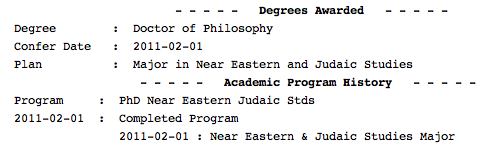 I finished revisions on the dissertation and handed in all the requisite paperwork back in August but have been in “lame doc” status since 8/20/2010. My doctoral liminality has finally come to an end.
Why I don’t give quizzes

(comic from SMBC Comics)
Update on Egyptian Artifacts
Dorothy King (PhDiva) has a comprehensive roundup of the situation in Egypt at the moment. Things don’t look good, but they aren’t nearly as dire as they could be given the tense political climate.
Night of Looters in the Egyptian Museum
Distressing news from Reuters:
CAIRO Jan 29 (Reuters) – Looters broke into the Egyptian Museum during anti-government protests late on Friday and destroyed two Pharaonic mummies, Egypt’s top archaeologist told state television.
[snip]
The two-storey museum, built in 1902, houses tens of thousands of objects in its galleries and storerooms, including most of the King Tutankhamen collection.
The museum is adjacent to the National Democratic Party’s headquarters, around whom the protests are centered. It makes sense that the headquarters and the museum would be come linked in the minds of the protestors.
It’s like Iraq all over again.
Ironic and Depressing Humor in Academia
I’ve been holding on to several tidbits of academical miscellanea and have decided to roll them into one larger post.
First is this PhD Comics strip that parses what your advisor’s email signature indicates.

After reviewing this chart, I reviewed emails from my advisors last summer and am both amazed that I was able to defend and grateful that that the comic didn’t come out while I was in the midst of a flurry of revisions.
The second piece is this Simpsons clip about grad students and PhD’s.
I never had three thousand papers to grade at one time, but I was a thirty year old with a ponytail making little cash.
Finally, there is Peter Lemche’s review of David Carr’s An Introduction to the Old Testament: Sacred Texts and Imperial Contexts of the Hebrew Bible
Reading the sections about the Pentateuch is simply revealing. It is as far from the status quaestionis as one could imagine. No German discussion is ever mentioned or referred to, neither Blum or Kratz or Levin, to mention only a few contemporary authors. Neither is Van Seters contributions ever referred to. As a matter of fact, the only critical book mentioned may be Robert Carroll’s Jeremiah commentary, now ostracized from the Old Testament Library commentary series.
Alas there is very little that speaks in favor of this outwardly inviting little book. It is simply out of touch with the present state of critical biblical scholarship, not only in comparison to the more advanced state as represented by this reviewer, but also more traditionally minded critical scholars.
I post the above quote not to relish in a scholar criticized for the same thing he recently levied against another. Rather, I want to highlight Mark Leuchter’s comments against what he calls a “rhetoric of ferocious reviews.” I assume that neither Lemche nor Carr knew of the other’s review, and this makes their similarities inadvertently ironic and even more depressing—perhaps justifing the humor that is elsewhere made at the academy’s expense.
(HT to Aren Maeir for the Simpsons clip and to Jeff Stackert and Seth Sanders for alerting me of Lemche’s review)
Gilgamesh on Stage at the Bushwick
Blogcritics.org has a review of Immortal: The Gilgamesh Variations
The wooden staircase you climb to get to the Bushwick Starr theater has more character than some entire plays. You’re rewarded for the climb—through January 30, anyway—with a strenuous, rewarding journey through the ancient Sumerian-Akkadian Epic of Gilgamesh, one of the earliest works of literature in history. Sumerian legends told of a semi-divine hero-king, Gilgamesh, who tyrannized his subjects in the city of Uruk until they pleaded with the gods for help. In response they created Enkidu, a primitive man of great strength who lived in the forest with the beasts until being seduced by a temple harlot into coming to Uruk to be a companion to Gilgamesh.
What is most interesting to me about this production is the rotating choice of actors for Gilgamesh: “A different actor plays Gilgamesh in each ‘tablet,’ all ably, while Enkidu remains in the sure hands of the very physical actor who goes by the name of Eugene the Poogen.” In the actual traditions, both Gilgamesh and Enkidu’s roles change as the tale developed, though Gilgamesh seems to have undergone more revision—especially if you take Tzvi Abusch’s understanding of the three different Gilgameshs in the Akkadian epic.
(HT: PaleoJudaica)
New Inscription Resource
Semitic Inscriptions Sémitiques:
This website is a database of ancient texts written in Semitic languages and inscribed on various media: tablets, potteries, manuscripts, etc. It grants direct access to all kinds of information about these inscriptions: their origin, their age, their script… And of course, most importantly, the text itself, analyzed, translated, and annotated.
Looks promising. At this point they only have a half dozen inscriptions, but could be useful if the number of texts grows sufficiently and the search engine is robust enough to handle complicated parameters. They say to use Firefox on the cite, but I found Chrome works as well.
(HT: AWOL)
Seminary and the Art of Motorcycle Maintenance
In an attempt to keep in touch with students, I’ve taken to reading the Philly Metro. (For those unfamiliar with this publication, it’s a free daily paper in Philadelphia, New York and Boston with a reporting style that is like Sparks notes of USAToday.) The other day the Metro had article by Judy Weightman entitled “Considering an Education Option That’s Best for You.” I found the following quote interesting:
You may not need a traditional college degree. Depending on your career goal, you might do best with a school that will train you for that career. Examples are skills training for specific trades (like carpentry, hair-styling or auto mechanics) schools in the performing or visual arts and seminaries or rabbinical schools. (Emphasis mine)
What I found interesting about this quote is 1) it implies that you do not need a college degree to attend a seminary or rabbinic school, and 2) it equates an ecclesiastical calling with auto mechanics. I’ll leave the latter for others to decide, but I’m certain the first is wrong.
Vacation Effect
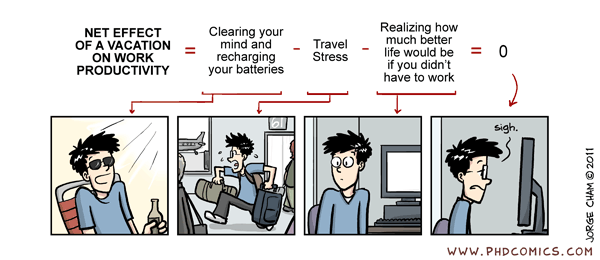
(from PhD Comics)


 Ketuvim: the Writings of James R. Getz Jr.