Book Proposal Solicitation
Alan Lenzi is asking for book proposal to SBL’s newANE Monograph series:
Many SBL Forum readers will have heard about a new online, open-access monograph series. It is called Ancient Near East Monographs / Monografías sobre el Antiguo Cercano Oriente (ANEM/MACO). This is one of several projects that have been spearheaded by the SBL’s International Cooperation Initiative. This new peer-reviewed series publishes volumes on any aspect of the ancient Near East from the Neolithic to the early Hellenistic eras, including works on ancient Israel and the Hebrew Bible. The open-access nature of the series means that it is globally available. Moreover, it publishes volumes in English and Spanish and some of its English volumes will be translated into Spanish to reach an even wider readership—the series is a joint project of the SBL and the Centro de Estudios de Historia del Antiguo Oriente (CEHAO) of the Pontifical Catholic University of Argentina. The same scholarly standards that apply to any SBL series apply to ANEM/MACO and it is led by an international editorial board comprised of both senior and junior scholars. The series is currently accepting proposals. As a member of the editorial board, my purpose in writing this brief essay is to encourage members of the SBL to submit their series-appropriate manuscripts or proposals.
Read the rest of the article over at the SBL Forum.
The Genesis of an Idea
Today I start teaching Genesis in my humanities seminar courses. I post this comic from Nick510 in honor of the this semesterly event.

Higher Ed, the Google, and the Wikipedia
My department had a meeting today on information literacy and source evaluation. A large portion of the discussion focussed on how we as educators could teach our students to evaluate online sources. In the midst of this discussion, one the research librarians present brought the following report from Project Information Literacy to our attention:
How do students evaluate information and use it once they have found it? What difficulties do students encounter with research for courses and for personal use from start to finish? Read PIL’s “Truth Be Told: How College Students Evaluate and Use Information in the Digital Age” with findings from 8,353 college students from 25 colleges and universities in the U.S. Watch the preview video (3:05) and read the report (72 pages, 5.8 MB).
The document is long but worth the read. One graph in particular, however, deserves special attention:
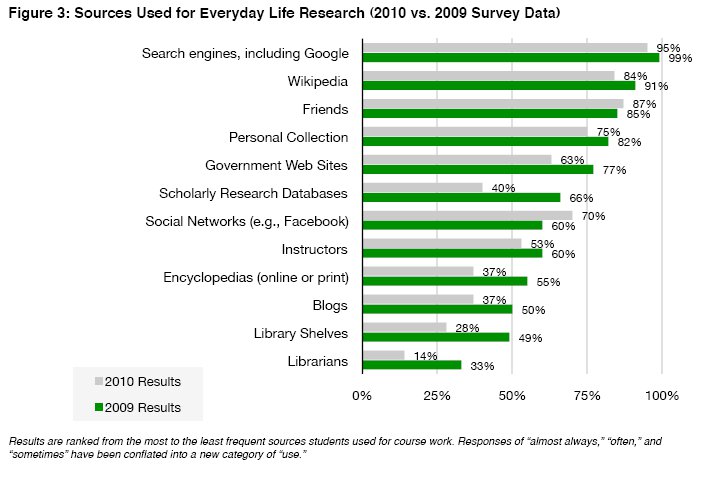 Basically, students are almost twice as likely to hit Google than talk to an instructor about research and are almost seven times more likely to hit Google than to talk to a librarian. The number concerning Wikipedia are almost the same.
Pretty wild, but important to realize.
Jesus, Buddha and Manga
 Do you love manga and revered religious figures? Then I encourage you to check out S. Brent Plate’s nifty little piece over at The Revealer on a manga revolving around Buddha and Jesus.
I stumbled upon the manga title Seinto Oniisan
, which usually gets translated into English as “Saint Young Men,” but also carries “brotherly” connotations. The brothers in question are none other than Jesus and Buddha, who take a vacation from otherworldly life to shack up together in the Tokyo suburb, Nachikawa. They share a spartan, tatami-clad flat, wonder over new technology, do their own laundry (mostly jeans and t-shirts with various Buddhist and Christian references), visit amusement parks, get their food from the local 7-11, and celebrate Christmas and Shinto festivals. The local school girls are attracted to Jesus because he looks so much like Johnny Depp, which makes him happy since people in the 21st century might actually like him; he comes off as a bit of a hippy slacker and wears his crown of thorns around like a bandana. The Buddha enjoys napping, usually sleeping in the pose of the great reclining Buddha, or downing a can of Sapporo beer in response to too much asceticism, while the young girls think he looks like Buddha and the Western tourists think he looks like a ninja.
Check out the rest of Brent’s post for interesting thoughts on what such texts might mean for religious literacy and the next generation.
The first few issues of the manga are available in a scanlation at Megachan.
(via Iconic Books)
Humanities and the Digital Age
The New York Times has an article up by Patricia Cohen on how humanities scholars are embracing digital technology. This quote nicely summarizes the piece:
As Brett Bobley, director of the endowment’s office of digital humanities, explained, analyzing unprecedented amounts of data can reveal patterns and trends and raise unexpected questions for study….
Mr. Bobley said the emerging field of digital humanities is probably best understood as an umbrella term covering a wide range of activities, from online preservation and digital mapping to data mining and the use of geographic information systems.
It’s exciting to see the implications of this technology. Digital resources in the ancient Near East in particular are moving quite quickly. With most of the artifacts strewn in libraries and museums across the globe, digitized media is making it easier to access information.
Notice the present tense at the end of the last paragraph. The future is now. If you’re reading this, chances are you already have figured this out. To cite only the most recent example, take a look at John Hobbins’ piece today on Why web publishing is ten times better than dead tree publishing. It’s quite amazing what we can now do even in such a standard idiom as the book review.
Of course, there are problems. The blogosphere has been abuzz recently about the technological blunders surrounding the upcoming SBL national meeting. The most interesting discussions revolve around the $25-75 cost of using a digital projector, the usefulness of handouts, and the apparent lack of wifi in the convention center. To my mind the last is the most damning to those of us who are technologically dependent.
However, our ilk is not alone in this lag time, as the article also notes:
Most humanities professors remain unaware, uninterested or unconvinced that digital humanities has much to offer. Even historians, who have used databases before, have been slow to embrace the trend. Just one of the nearly 300 main panels scheduled for next year’s annual meeting of the American Historical Association covers digital matters. Still, universities, professional associations and private institutions are increasingly devoting a larger slice of the pie to the field.
Let’s hope this trend continues.
C.I.E.
 I often tell my students that the most important rule of reading, interpreting and translating is C.I.E.—Context Is Everything. This can clearly be seen by this comic by Cat and Girl. (Click the image to enlarge.)
Consumerist Wants
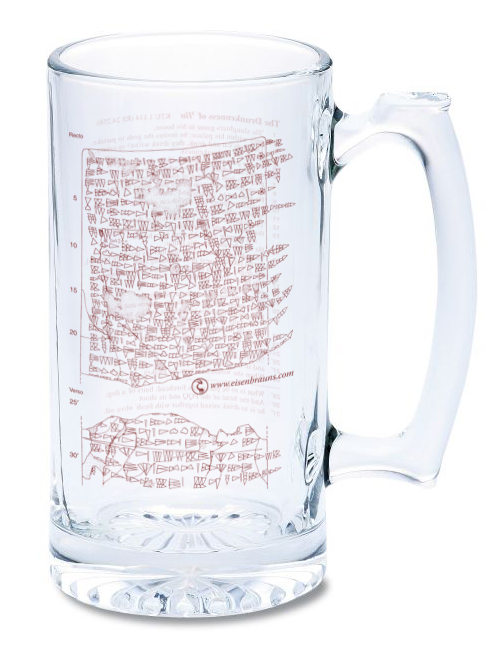 James Spinti has pics up over at his blog of the Eisenbrauns crew partaking of root beer floats in their new ‘Ilu Drinking Party mug.
Of all the mugs that Eisenbrauns has offered over the years, the ‘Ilu Drinking Mug might be the most anticipated. Given that this prestigious list includes an Enuma Elish Cuneiform mug and a hundred anniversary Gezer Calendar mug, I find this impressive.
Herodotus on Twitter
PRLog notes that Herodotus’ The Histories has entered the age of Twitter:
Herodotus, who wrote his History of the Persian Wars in the 5th century B.C.E., is using social media to bring his story to a modern audience. He announced on his Twitter account (@iHerodotus) Friday that he would begin tweeting his History, one section per day, one tweet (he anticipates) per section. The project is expected to take almost five years: the last tweet should be posted in January of 2015.
A web 2.0 Herodotus is not a new idea. I posited a wiki Herodotus back in 2008. My musings were in reaction to Daniel Mendelson’s review of The Landmark Herodotus: The Histories
It occurs to you, as you read “The Landmark Herodotus”—with its very Herodotean footnotes, maps, charts, and illustrations—that a truly adventurous new edition of the Histories would take the digressive bits and turn them into what Herodotus would have done if only they’d existed: hyperlinks.
Personally, I hope that the Twitter edition makes full use of hyperlinks, twitterpics and other forms of connectivity that the medium allows.
(HT: Chuck Jones via Facebook)
New Scholarly Society!
Via Jim Watts at Iconic Books:
I’m very happy to announce the launch of a new scholarly society: The Society for Comparative Research on Iconic and Performative Texts(SCRIPT).
Its goal is to foster academic discourse about the social functions of books and texts that exceed their semantic meaning and interpretation, such as their display as cultural artifacts, their ritual use in religious and political ceremonies, their performance by recitation and theater, and their depiction in art. SCRIPT then incorporates the interests of the Iconic Books project, but also invites broader consideration of both iconic and performative dimensions of texts.
The society will sponsor programming at existing regional and international scholarly meetings and at colleges and universities. The first of these will be a concurrent meeting with the Eastern International Region of the AAR at Syracuse University, May 6-7, 2011 (see the Call for Papers).
We welcome new members and ideas for programs and venues to host them.
They had me at ritual…
The Real Vote is Still to Come!
Forget which party now controls which house in the States, Chip Hardy has a more important poll on which you should focus.
Which ANE mug shall reign supreme: Eisenbrauns’ ‘Ilu Mug or the Oriental Institute’s Writing Exhibit mug? As a scholar of Northwest Semitic texts, the choice for me is obvious.


 Ketuvim: the Writings of James R. Getz Jr.