Map of the History of Science Fiction
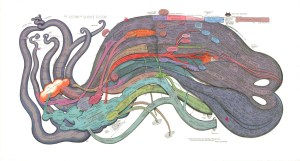 Brooklyn-based artist Ward Shelly has compiled a map of science fiction starting with the early twining of “fear and wonder” and moving through most of western thought. Gilgamesh gets an early shout out near the top left, but the important role of the Bible seem to has been glossed over. However one interprets the fantastical elements in the biblical accounts, its narrative influence cannot (and should not) be ignored. For example, it’s hard to imagine or understand Rutger Hauer in Blade Runner without reference to the Bible.
(HT: Strange Maps)
SBL Survey
By way of the SBL Newsletter:
Biblical Scholar Survey: How do you work with Sacred Texts?
You are invited to take part in a short on-line survey that is sponsored by the Psychology and Bible Studies Section of the SBL. This programme unit investigates both psychological aspects of biblical writers or texts, and the ways in which psychology influences how readers interact with texts.
This survey builds on previous studies that have shown a link between psychological functioning and interpretation among a range of bible readers, both clerical and lay. Although psychological profile is only one of many factors that influence the way that sacred texts are handled and interpreted, it does have some effect that seems to persist across a wide range of ‘ordinary’ readers. The aim of the study is to see if this link holds true for biblical scholars, or whether scholarly interests and methods of handling sacred texts are entirely independent of psychological preferences.
The questionnaire takes around 10-15 minutes to complete and contains sections that assess the way that you study and handle texts, your psychological profile and some essential background information.
The results are entirely confidential and anonymous, and cannot be linked to your personal or digital identity.
To access the survey please go to:http://www.survey.bris.ac.uk/yorksj/sblsurveyIt will not take you long to complete and your co-operation would be greatly appreciated.
Dr Andrew Village
York St John University, UK.Email: a.village [at] yorksj.ac.uk
Webpage: http://w3.yorksj.ac.uk/trs/staff/andrew-village.aspx
MidAtlantic Regional SBL Recap
There are a variety of things happening in and around the Society of Biblical Literature to make note of, but this post can only comprise what’s been going on in the MidAtlantic region.
The MidAtlantic Regional meeting was this past Thursday and Friday (March 17th-18th). The conference had a generally strong group of papers. The overall theme of the conference was embodiment and the embodied self, which came together quite nicely in the plenary address with Lawrence Schiffman and the presidential address by Maxine Grossman.
I feel the need to single out a few papers that were of particular interest. As already posted by Stephen Cook, Jeremy Hutton gave a fine paper arguing for a Gt (tip’el) in Jeremiah 25:34. Calvin Park of The Floppy Hat gave a paper on the grammar of Hab 3:4. And, Chip Dobbs-Allsopp and Tod Linafelt gave a stimulating paper entitled “Elements of Biblical Poetic Style.” Stephen Cook gave an equally stimulating response to the paper—I would love to obtain copies of each. I don’t want to be egregiously unfair, but I was quite impressed by all the presenters in the Pentateuch section this year. We had a good balance of traditional historical-critical scholarship and more new-literary and ideological-critical models. Something (I hope) for everyone.
Speaking again of Stephen Cook, he is the new president of the region. As one interested in ritual studies, I was intrigued what would indicate the transition of power. Taking a scepter (or dry-erase marker?) would have been nice or perhaps a more physical representation of the mantle of leadership being conveyed from Dr. Grossman—in line with high-priestly garments passing from Aaron to Eleazar, but without the subsequent demise of the former. Sadly, it was merely a performative speech act.
RBL review of Nicholas Wyatt
The new batch of reviews at the Review of Biblical Literature contains one of interest for Ugariticians: John Engle’s review of Word of Tree and Whisper of Stone by Nicholas Wyatt.
This volume is a collection of eight articles by Wyatt over a fifteen year period (1992-2007). Engle has a quite difficult task in reviewing this disparate group of material. He does a great job at summarizing Wyatt’s arguments in these articles but doesn’t really engage in the material critically.
However, anyone who has engaged with Wyatt’s arguments knows that they provide scholars with a complicated rabbit trail that often involves three or more articles in disparate journals and books. As such, Engle can be forgiven for his summarization.
Fourth Blog Anniversary
 Today marks this blog’s fourth anniversary. Apparently, this means I should buy it either fruit/flowers or appliances.
(Image via Anniversary Graphics)
Wither Sapanu?

Ba'lu looking for his home on the net
Today I was reading a section of the Ugaritic tale of Kirtu (CAT 1.14-16) on the train and wondered how often and where a certain word occurred. I decided to look it up on Sapanu, since I did not have at hand my copy of del Olmo Lete and Sanmartín’s Dictionary of the Ugaritic Language in the Alphabetic Tradition. (I keep it in a lock box, along with my other precious commodities, such as gold bullion, family heirlooms and of course other Brill volumes.) However, the ABZU link did not work, and even some reverse engineering did not lead me to any usable information.
I’ve had problems connecting to Sapanu before but didn’t really have the time to find out what happened to them. The Banco de Datos Filológicos Semíticos Noroccidentales used to contain a searchable datebase complete with likely reconstructions of texts. It was clunky, buggy and used a unique and problematic font, but it was the best we had. Does anyone know what happened to it?
I suspect that the publication of A Concordance of Ugaritic Words and The Texts of the Ugaritic Data Bank by Jesús Luis Cunchillos might have something to do with the site being left fallow, but I could be wrong.
Seven Stages of Grading
Prof-Like Substance has diagramed the seven stages of grading for those of us tweed-deep in papers, exams and other forms of assessment. Click the link (or the image) for full description of each stage.

SBL National Paper on Kirtu Accepted
Today I received word that a paper I proposed for the Society of Biblical Literature national meeting has been accepted. It seems strange to be thinking about the fall conference, when the spring MidAtlantic Regional is still two weeks away. The approved abstract I submitted to the Ugaritic Studies and Northwest Semitic Epigraphy unit is below the fold for your viewing pleasure (with my apologies to Lemony Snicket
Dissertation on ProQuest
Apparently my Dissertation is now on ProQuest:
Abstract
Both Ugaritic and biblical texts contain rites whereby the status of an individual is temporarily enhanced to distinguish that person from other ritual participants or society in general. These rites enable such a person to function in proximity to the deity in cultic activities or to be analogically associated with those who so function. These rites differ from rites of crises (such as purification rites) and from rites of transition (passage) in that they have calculated performances at the beginning and end that mark the initiation and termination of the status change. The status change does not begin inadvertently nor is it intended to last indefinitely.
Ugaritic materials display rites of temporary cultic status change in ritual and narrative texts. The ritual texts describe rites whereby the Ugaritic king is sacralized and desacralized in order to perform certain cultic functions. The sacral status is created by a rite in which the king washes himself pure and terminated by a rite possibly involving cultic functionaries. The narrative texts provide another example in the story of Aqhatu, where a rite in the narrative allows the ritual participant (Dani’ilu) cultic access otherwise unavailable.
Examples from the Bible are in texts that broadly belong to the priestly tradition: the Priestly Torah, Holiness School, and cultic material in Ezekiel. The temporary status change of the Nazirite to one analogous to the high priest in Numbers 6 and the temporary access to the holy of holies given the high priest in Leviticus 16 serve as a basis for examining temporary rites of cultic transition in the Bible.
The significance of this newly identified class of rituals lies in their particular social and religious function. Rites of temporary cultic transition allow access to the cult for those normally outside its confines, allowing those outside the cult to approximate the status of regularly installed functionaries. They can even temporarily enhance the status of permanently installed cultic functionaries to perform ad hoc or irregular ritual activities. As such they reinforce the importance of these categories while allowing the opportunity to transcend them for a limited time.
Yup. That’s what I wrote.
Biblical Studies Carnival is up
 Matthew Crowe has the latest carnival up at his blog, A Fistful of Farthings.I haven’t been very good as of late with posting links to the BSC. If my calculations are correct, this should be Carnival LXIII. But, I could be wrong.


 Ketuvim: the Writings of James R. Getz Jr.