A Winter Sort of Thing
 Any and all folks living in the Philly area (especially those with kids) should try and make Yes! And…‘s Winter Sort of Thing production “The Clean Green Machine.”
Yes! And… does collaborative urban theater work here in Philly, teaching young people social and life skills while making art.
It will be quite fun. (And my kids are in it too!)
Kirtu’s Mountaintop Experience
In the beginning of the Story of Kirtu (CAT 1.14-16), the king is bereft of kin and is weeping in fetal ball. The god ʾIlu descend to him and in a dream discusses Kirtu’s plight. Kirtu is called upon to perform a ritual and then go off to war. However, much of this mountaintop experience is still problematic to scholars. One issue is what Kirtu is to do for/with Baʿlu on the tower’s rooftop. Read more…
Book Withdrawn
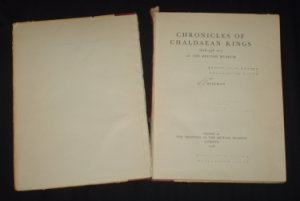 Every time I go to Temple’s library I check the withdrawn cart. Usually there is little to nothing of interest, but you don’t know unless you look, right?
Well, today on the cart my wondering eyes spied J. D. Wiseman’s Chronicles of Chaldean Kings. As you can see, it will need a little TLC. Luckily I know a little bit about bookbinding and restoration. Aside from the cover damage the books is beautiful, with all twenty one plates in pristine condition. I am a very happy man.
Eisenbrauns ANE Poetry Contest
 It’s time once again for the Eisenbrauns ANE love poetry contests:
Love is in the air! We’re looking for a few good scholars to display both eros and erudition in our second Ancient Near Eastern Valentine’s contest.
We want no more than three of your original* compositions, in any ancient Near Eastern language (yes, we’ll take Greek, too), accompanied by an English translation. Artwork is similarly welcome (please make sure your submissions are workplace friendly). All entries should be sent via e-mail to akerr at eisenbrauns dot com before noon on Wednesday, February 11.
The decisions of the judges will be final and, most likely, extremely arbitrary. Prizes will be Eisenbrauns gift certificates: $75.00 for first place, $50.00 for second, and $25.00 for third place. Winners will be announced on February 13, 2009, and winning entries will be showcased on the Eisenbrauns website. Submitting an entry constitutes permission to reproduce your work.
* We have memorized the entire corpus of Near Eastern poetry, and will be watching for cheating. OK, we haven’t — but someone out there will catch you at it if your words are not your own, and that wouldn’t be good. So don’t.
Who knows? Maybe this year I’ll get a chace to pen (stylus?) a few lines of Ugaritic verse…
Brilliant Moment
I’ve been catching bits of the spectacle that is the inauguration of Barack Obama with some interest. The whole affair is an amazing use of political ritual. However, this was just cool:
Ugaritic Lexicological Lunacy
Ever notice that there’s no standardization in Ugaritic lexicography? Obviously, everything was a bit fluid back in the early years of the field, but a sort of forced consensus occurred with Cyrus Gordon’s Ugaritic Textbook.
However, in recent years this consensus has fallen apart. Looking up a word in different Ugaritic reference tools requires one to learn several competing systems.
For example. Gregorio del Olmo Lete and Joaquin Samartín’s A Dictionary of the Ugaritic Language in the Alphabetic Tradition
ʾʿbdḏgğhḥḫklmnpqrsṣštṭṯwyzẓ (with ś interspersed with s)
But, Daniel Sivan’s A Grammar of the Ugaritic Language
ʾbgdḏhwzẓḥḫṭyklmnsʿpṣqrštṯn (with ś interspersed with s)
Jesus-Luis Cunchillos’ A Concordance of Ugaritic Words orders the data:
ảỉủbgdḏhwzẓḥḫṭyklmnsśʿğpṣqrštṯ
One could argue that Cunchillo’s seperate entries for each ʾaleph and for the s and ś makes sense for a concordance. Yet, the major differences of Cunchillos and Sivan over against the dictionary of del Olmo Lete and Samartín is still striking. Apparently, the latter authors are following the Assyriological precedent for ordering their dictionary according to the Latin alphabet, while Cunchillos and Sivan are following Gordon in ordering according to the Hebrew alphabet.
I just wish they’d make up their mind. It’s starting to give me a headache.
Book Sadness
 I’ve been watching the books come through Eisenbrauns’ used books with idle curiosity. The windfall consisted mostly of Assyriological works; and the few Northwest Semitic titles I had seen were all ones I already owned.
The only volume I was really interested in was La langue de Ya’udi by Paul-Eugène Dion. The title came up earlier this week, but at a price of $75 dollars. Alas, for that price I had to pass yet again. Someone picked up a sweet and rare find. I’ll have to continue to rely on the kindness of strangers libraries.
Kirtu: Tragi-Comedy or Pure Tragedy?
I know they say that we laugh and cry about the same things, but I really have a hard time seeing the following summation of the Ugaritic story of Kirtu by Baruch Margalit as anything other than macabre:
Keret is miserable a the beginning of the story for want of a son and heir; he is equally miserable at its conclusion precisely because of his son and heir. If the curse were not so funny—Yaṣṣib examining his teeth in the cup of his hand—the ending would indeed be sad. This is the essence of the poem as tragi-comedy, mixing the tears of laughter with those of pain.
(B. Maraglit, “The Legend of Keret,” Handbook of Ugaritic Studies, 214.)
To me, the story of Kirtu is tragic, pure and simple—an old king having to fight off an heir-apparent turned usurper.

Open Letter Concerning the Recent Firing of the University of Pennsylvania Museum Researchers
I’d encourage everyone to go and sign the following petition:
Open Letter Concerning the Recent Firing of the University of Pennsylvania Museum Researchers
To: ARCHAEOLOGISTS AND THE CONCERNED COMMUNITY AT LARGE
To whom it may, it should or it would concern,
We the undersigned, academics and graduate students who are engaged with the future of archaeology, are deeply troubled by the recent announcement of the termination of eighteen research specialist positions at the University of Pennsylvania Museum of Archaeology and Anthropology, the abolishing of those research positions, and the shutting down of their associated laboratories and centers such as MASCA (the Museum Applied Science Center for Archaeology). We understand this gesture as a wholesale dismantling of the research mission of the University Museum, which has been at the forefront of international archaeological studies since the museum’s foundation in 1887. We would like to bring to public attention that this is a historic decision in the long-term history of the University Museum, and we reject that this is simply a strategic tightening of the belts at the time of a financial crisis, as it has been widely claimed by the Museum administrators in the popular media.
Our main concern is related to the long-term identity and mission of the University of Pennsylvania Museum of Archaeology and Anthropology. We are confident that University administrators are aware of the University Museum’s unique status as a research institution that has carried out many historically significant archaeological projects, most notably in the Middle East, the Mediterranean World, and Mesoamerica. In this way, like the Oriental Institute of the University of Chicago, the University Museum has uniquely characterized itself, as stated on the museum’s own website, as a research institution to “advance understanding of the world’s cultural heritage” (see the Museum’s mission statement). We understand the dismantling of the research infrastructure of the Museum as a drastic surgical gesture, a decisive act that will discontinue the possibility of future archaeological research in the above-mentioned fields. We hope that the Museum administration, the Provost, and the President understand the long term responsibilities and the consequences of this historic decision.
Many of these researchers, such as Patrick McGovern, Kathleen Ryan, David G. Romano, Simon Martin, Barbara J. Hayden, Philip G. Chase, and Naomi Miller are high-profile senior researchers in their respective fields. They have contributed to the intellectual environment of the University and the greater archaeological discipline with their research, their numerous publications, and teaching for many years. We feel that the firing of these researchers in this financially strained environment is unfair since they may not be easily employed elsewhere at this time with their laboratory and facilities needs. Additionally, the administration’s financially motivated decision not only violates academic ethics of respect to such scholarly accomplishments and intellectual labor, but also ignores the institutional memory of the University Museum all together. We urge the University of Pennsylvania and the University Museum administrators to reconsider their decision, to find ways to restore and fund the research positions, and to rehire for next year the research specialists who are now to be laid off.
We would like to remind the administrators that universities are not for-profit businesses, rather they are institutions of research and teaching whose component parts need to be supported and protected, especially in tough financial times. While calling for the reinstatement of the researchers, we also recommend the establishment of a Archaeological Research Grant Support Office in the University Museum. This will encourage the units to become more financially self-sustaining while at the same time provide guidance and grant-application support for the research specialists to alleviate some of the burden that comes with the arduous process of preparing grant applications. In addition, one of the criticisms directed at such research positions has been their disconnection from the teaching environment at Penn. We suggest then that it would be helpful to redefine these positions with greater interaction with students, some teaching responsibility, and greater public outreach.
We would like to reiterate that the discontinuation of eighteen research positions at the University Museum and the abolition of research centers and laboratories very well might be an irreversible decision for the future of archaeology both at Penn and in the broader field. Furthermore, this is undeniably a reversal of the original mission of the University Museum, as a research institution that supports both public intellectuals and contributes to the scholarly understanding of human past.
Sincerely,
Upcoming Lecture on the Trojans
There’s an interesting lecture occuring on Jan 6th at the Penn Museum as part of it;s Great Sites Lecture Series: The Trojan War — Myth or Fact? Recent Excavations at Troy.
Dr. C. Brian Rose, deputy director at the Penn Museum, speaks about renewed excavations at Troy during the past 20 years that have focused on nine settlements from the beginning of the Bronze age (ca. 3000 BC) through the end of the Byzantine period (ca. aD 1400). An assemblage of gold jewelry in the Museum’s collection, dating to the same period as Heinrich Schliemann’s Treasure, will be on view after the lecture.


 Ketuvim: the Writings of James R. Getz Jr.