Musings on Divine Kingship
Divine kingship is a tricky thing. Steve Wiggins has written an excellent post on divine kingship over at his blog. His post combines data from the ancient Near East with traditions of divine kingship in Mesoamerica and with our modern world. I want to spend a moment to ruminating on some of the extended problems surrounding the issue in the ancient Near East, muddying the waters a bit. Read more…
Can the Israelites ever have sex again?
As part of the revisions for my dissertation, I am looking at the ritual proscriptions in Exodus 19 where by Moses sacralizes the people of Israel through lustration and prohibition of sexual contact. However, what I am trying to discover is when this state of heightened ritual purity ends. Read more…
A Cursory Glance at Israelite Cuneiform

I’m in the throes of preparing for my dissertation defense (this Thursday, 7/22/10), but I felt I finally had to jump in on the recent discoveries of cuneiform tablets in Israel. By far, the most startling discovery has been that of a (small) tablet fragment in Jerusalem. Given the wonderful work at Hazor, I for one was surprised by the discovery in Jerusalem. Jerusalem has been so often been stripped down to bedrock by successive inhabitants and been the focus of such intensive excavation that I continue to be amazed by the luck of the archaeologist’s spade.
However, my surprise was compounded today by the announcement that not only has a tablet been found at Hazor, it shows similarities to Hammurabi’s law code! Immediately my thoughts turned to David Wright’s recent book Inventing God’s Law
Wright’s argument for literary dependence is tight, but his date is debatable given these recent discoveries. However, I’m not about to date the Covenant Code to the Late Bronze Age on the basis of one fragment (see similar ruminations by Seth Sanders).
Hopefully I’ll be able to give all these wonderful new discoveries their just due after defense.
(HTs: Duane Smith, Robert Cargill, and basically anyone else watching Jack Sasson’s list closer than I am at the moment)
Great Resource on Ancient Languages
There’s a great resource out there for folks looking for information on ancient language of the Mediterranean called Mnamon.
Mnamon provides information on the best and most useful material available on the web for the research and study of ancient writing systems in the Mediterranean: archives, research centers, bibliographies and teaching materials.
They have a lot of really great resources on languages as varied as Akkadian Cuneiform and Hieroglyphic Luwian. At the moment they don’t have any resources for the less exotic languages Ugaritic or Aramaic, but the the resource should be quite useful.
(HT AWOL)
Looking for a Q Source
No, I haven’t crossed over from Hebrew Bible and ancient Near East to researching the Jesus festschrift. What I’m looking for is an author whose last name starts with Q.
Why? A silly conceit on my part: the bibliography of my dissertation runs the alphabetic gamut from Kjel Aartum to Evan M Zuesse with everything in between, except an author whose last name begins with Q.
So, if you can think of an author writing in biblical, Ugaritic or ritual studies whose last name begins with Q, send me a note. I’ve got about a week to find one.
A Celebration of Sorts
 Today marks the 2333rd anniversary of Alexander the Great’s death. In the short span of 32 years Alexander took the world by storm by unifying the Greek homeland, amassing a huge empire that span three continents and generally causing the world to go Hellenization in a hand basket.
On the one hand, you have to hand it to Alexander. The world might have been ripe for the sort of conquest he brought about, but it definitely took a special kind of charisma and strategy to make it happen. On the other hand, Alexander’s conquest of Mesopotamia was the final death blow to the older Akkadian culture that I so deeply love. It had been damaged by half a century of Neo-Assyrian aggression and Neo-Babylonian insurrection; it was being sidelined by the Persians; but the invasion of the Greeks and the coming of Hellenic culture is what finally did the old ways in.
Ironically, we know the exact date of death from a cuneiform astronomical text currently in the British Museum. The Greeks wind up nicking most of this Mesopotamian astronomical tradition (including their base sixty system for measuring angles).
A further irony is that Alexander died in the palace of Nebuchadnezzar II, the Neo-Babylonian king that lives on in infamy in the book of Daniel from the Hebrew Bible. Alexander gets a cameo in Daniel, appearing as the “great horn” in Daniel 8 (see the horn indicating the divinity of Alexander on the coin above). The two are linked in literature and in death.
(HT to Zack who reminded me of the day)
Geek Hierarchy
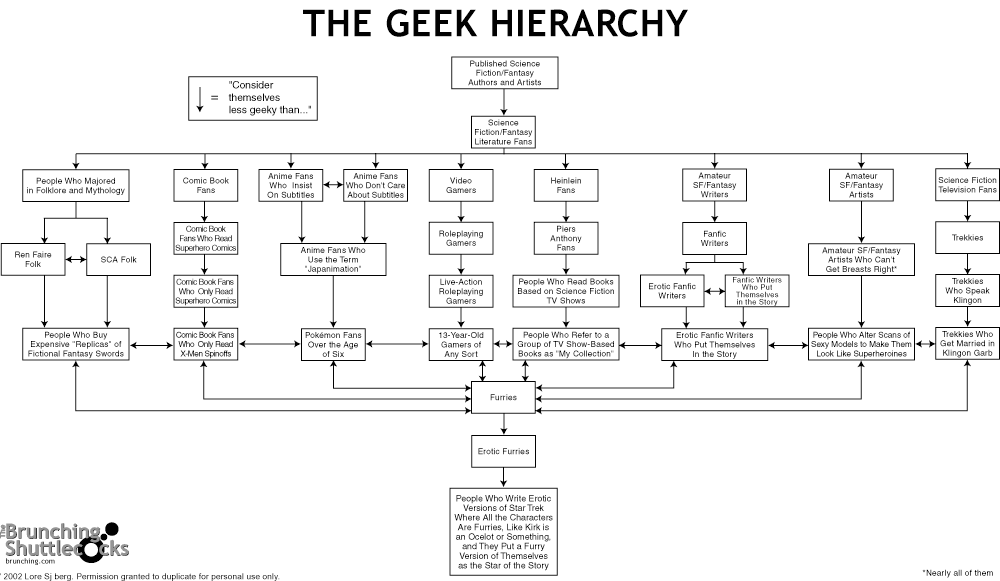 I came across this geek hierarchy by Lore Sjöberg the other day. It’s a big image; click to enlarge and to be enlightened.
In Memory of Jacob Milgrom
As many of you already know, on June 5th Jacob Milgrom passed. I can do know better than to link to a few thoughts by his former student, David Wright, of whom I am a student myself:
It is unfortunate to have lost Jacob Milgrom, one of the truly
outstanding Jewish scholars of the Hebrew Bible of the last and current centuries. The author of hundreds of masterful articles and several books since his academic career began in 1955, he will be best remembered for his two superb biblical commentaries, a three-volume work on Leviticus in the Anchor Bible series and a volume on Numbers in the JPS Torah Commentary.His work significantly altered the landscape of Pentateuchal studies by demonstrating the advantages and necessity of a close reading of the priestly prescriptions of the Torah (chapters on sacrifice, purity, festivals, and the priesthood). As it described and elucidated the system of thought in these texts, his scholarship revealed the integrity of priestly religion as a central phenomenon in ancient Israel. It also pushed scholars to reconsider the historical context in which these texts originated. His work became and will remain a foundational contribution to the understanding of Israelite and biblical religion.
(Read full text here)
Grading Rubrics

Courtesy of PHD Comics.
Even more Persian Tattoos
 As a follow up to yesterday’s post on the tattoo of Ahura Mazda, Chuck Jones tweeted me this post of more Persian tattoos. My favorite is the one to the left, obviously inspired by the Assyrian hunt motif that is sported on the State Archives of Assyria seal.
If I were and Assyriologist, I’d consider getting this piece. Nothing like showing your allegiance to the forces of order and culture over those of chaos, ignorance and discord. But as it is, I’m a Northwest Semiticist; and we all know of the aniconic trend in that art….


 Ketuvim: the Writings of James R. Getz Jr.